



Introduction
Liam Pierce is a Boston-raised software engineer and the creator of Subfolio, a submissions platform designed expressly for literary magazines and presses. As the son of AGNI’s editor, William Pierce, he’s been around magazine operations since he was a kid. He’s also been building software for most of his life and now works at Oracle, helping companies simplify their database designs and solve performance problems. In 2019, he founded Demon Database Management to help magazines and presses spend less time dealing with renewals, fulfillment, royalties, marketing, and even donor appeals. Now, he’s working to spread access to great submission management software for lit mags and presses. Subfolio, a product of Demon, is based in Boston, but Liam is currently working out of the San Francisco Bay.
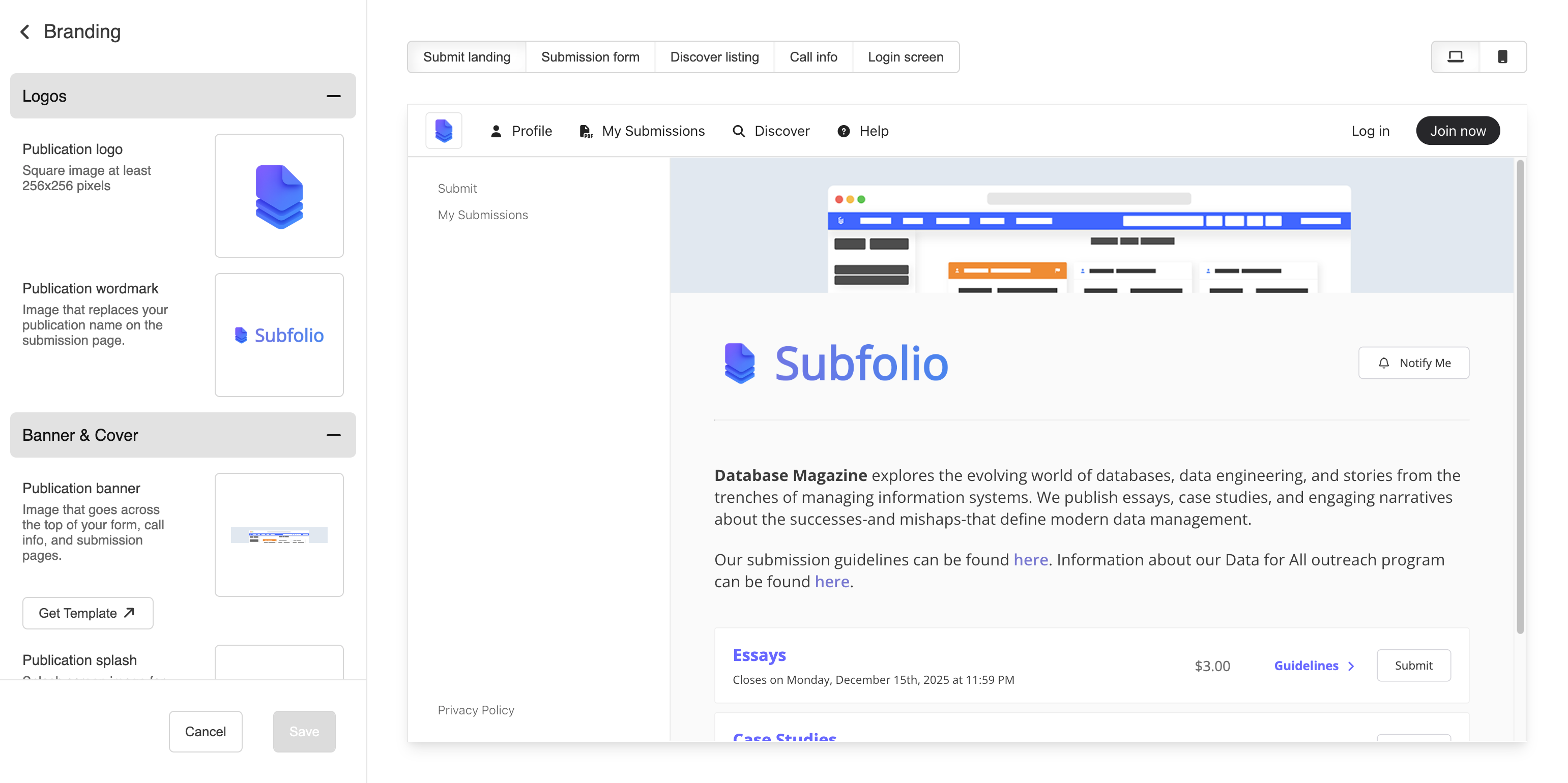
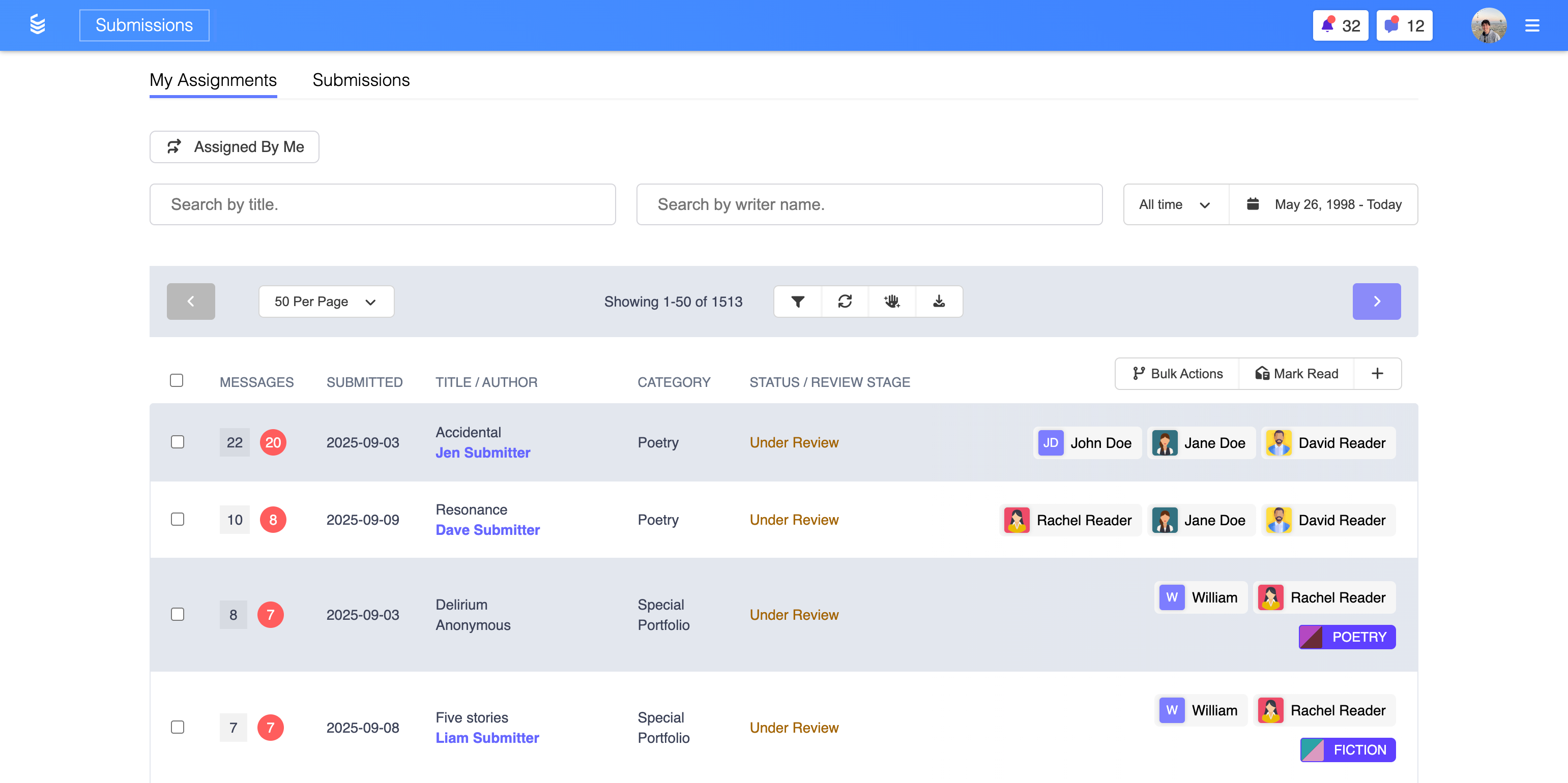
Subfolio is a submission platform purpose-built for the arts. Submitters can sign up and submit their work to literary magazines and presses, and magazines and presses can list calls for submissions. For submitters, it’s a user-friendly platform for responding to the submission calls that interest them. Whereas for publishers, it’s a place to create calls, review submissions, accept revisions, correspond with authors, pay their contributors, send contracts, and more. They can bring their whole reader team on board and find great work.
Q: Who can use Subfolio or really benefit from it? Is it just for lit mags and presses?
Liam: Subfolio is built for writers and artists to submit work to publications who ask to receive it. Of course, that means there are possibilities outside of literary magazines and presses, but Subfolio is focused on the literary community. Publications using email or Google Form submissions will find an easier interface, ready support, and a lively discover page to help bring submitters to their publication. Publications that use Submittable will find that Subfolio has the features they’ve come to expect, supports various review processes, and has a simple interface that’s easy to learn. Additionally, Subfolio and Demon have no outside shareholders, so I’m personally in control of the future of these platforms. Subfolio is built for the literary community, and it will stay that way.
Q: What led up to the creation of Subfolio?
Liam: Well, the story of Demon, and now Subfolio, is a long one—it stretches almost a decade back, to about 2016. I was in high school, and for years, I had seen my dad do tedious data work for AGNI. Order entry, renewal sorts, custom mail merge work—everything was difficult to do and duct-taped together. At the time, I had been working summers at a marketing software company in Boston, designing databases, cloud platforms, and server infrastructure, and I thought I saw a chance to make something that could save my dad tons of time. One night, while trying to help with a FileMaker script for a renewal campaign, I proposed creating a cloud software for him that would handle all the same things. It would automate the core of his data work. And that began the now ~10-year process of bringing Demon to life and expanding it to help other magazines and presses as well.
Flash forward, I’ve now worked closely with magazines and presses for all my adult life. I’ve seen many of the discussions around submission managers, the battles around pricing with Submittable, and the great work that CLMP has done to help rein in and resolve some of the problems; however, I noticed that there were still pretty huge gaps in terms of what was available. If you look at the current landscape, lots of lit mags and presses still take submissions by email, which can quickly become a nightmare. Even with discounts available, many orgs with smaller budgets can’t afford something like Submittable, and other offerings aren’t nearly as widely used or user-friendly, which directly impacts the number of submissions a place gets.
Then there’s the other side of things. Organizations that have “too many” open opportunities, need more account seats than the limit, or want a few features that should be standard, but aren’t, end up paying prices intended for government customers and large corporations. Even for smaller plans, the commission that Submittable takes on every paid submission adds up very quickly. Some organizations pay thousands a year just for their subscription, then many thousands more in commissions.
So, that’s why I started making Subfolio. I plan to continue developing Subfolio as a bustling ecosystem for writers and literary publications. I’m working to close the gap with cheaper access for smaller publications, far lower commissions on paid submissions and contests, so that publishers keep more of their revenue to pay authors and readers. There are no fees on tips, no per-sub fee for free submissions, so that orgs not charging submission fees will never pay more than the cost of their monthly subscription. No limits exist, so costs never explode. We support author payments in 58 countries, directly within the platform—a feature that’s available on both plans.
Q: How long did it take you to develop Subfolio?
Liam: With Demon already in place, I thought about making a submission platform for quite a while, especially as I heard more of the Submittable conversations. I finally started working on it in mid-2024. Subfolio is built on top of many of the same data engines and infrastructure that make Demon run, so I had quite a bit ready to go before I even started. It took a lot of very late nights (early mornings) and busy weekends to get it set for prime time. Without those previous years of work on Demon, it would have taken much longer. My years working in information security, database, and cloud have helped this project become what it is.
Q: How many open calls can publishers have open at a time with Subfolio? Do they get charged for expanding their team?
Liam: There is no limit to the number of calls a publisher can have open at a time, and there’s no limit to the number of “account seats”—that is, separate accounts for a single organization’s editors and readers. We don’t limit the number of questions a submission form can ask, either, so organizations can write submission calls that fit their real needs.
This point is really important to me. So many organizations run up against the limits of Submittable in one way or another, and that’s when costs can get out of control. The pricing (especially their commission) is already high; surpassing a limit can spike the bill. Subfolio gives a whole different kind of breathing room.
Q: Expanding on what was just covered, what makes Subfolio stand out from other well-known submission management systems like Submittable, and how does it differ from Dapple, Duosuma, Ola, or Moksha? Share at least 3-5 key distinct features with us.
Liam: It’s a passion project that’s been solving literary nonprofits’ very real problems for 10 years and counting—independently owned and run by me, that tailors software specifically to this community’s needs. In my mind, the biggest difference between other platforms and Subfolio is what we put first:
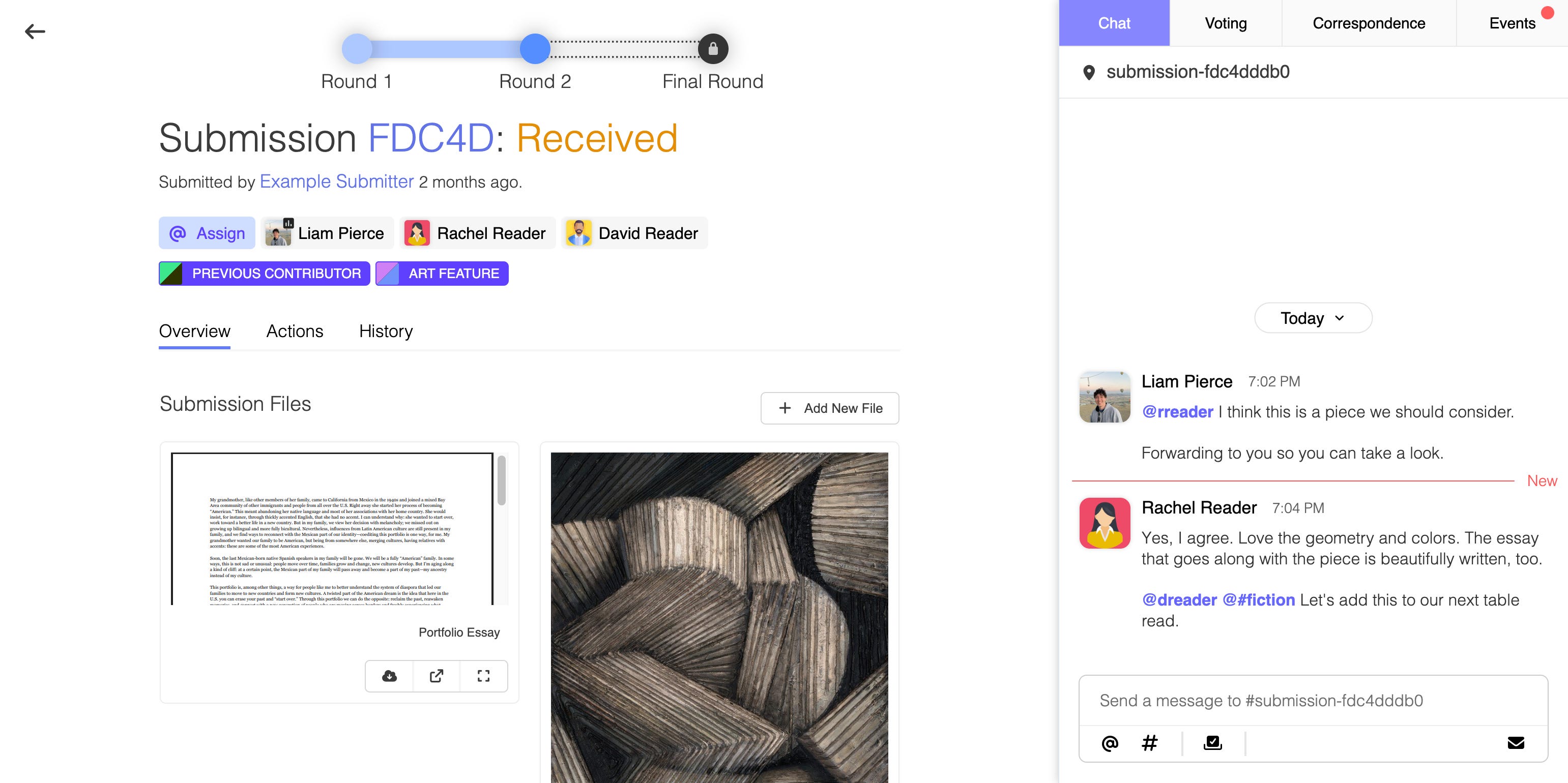
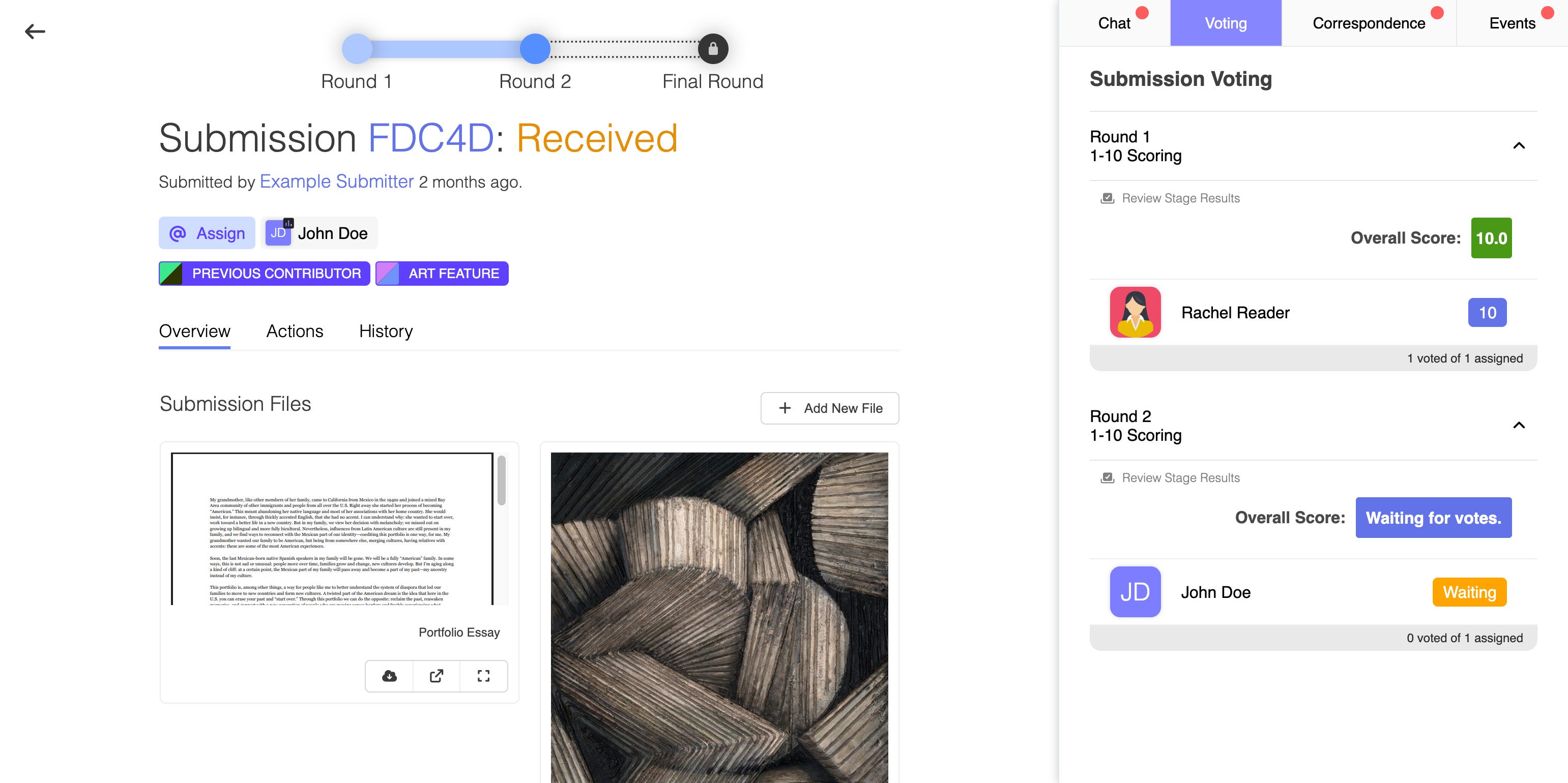
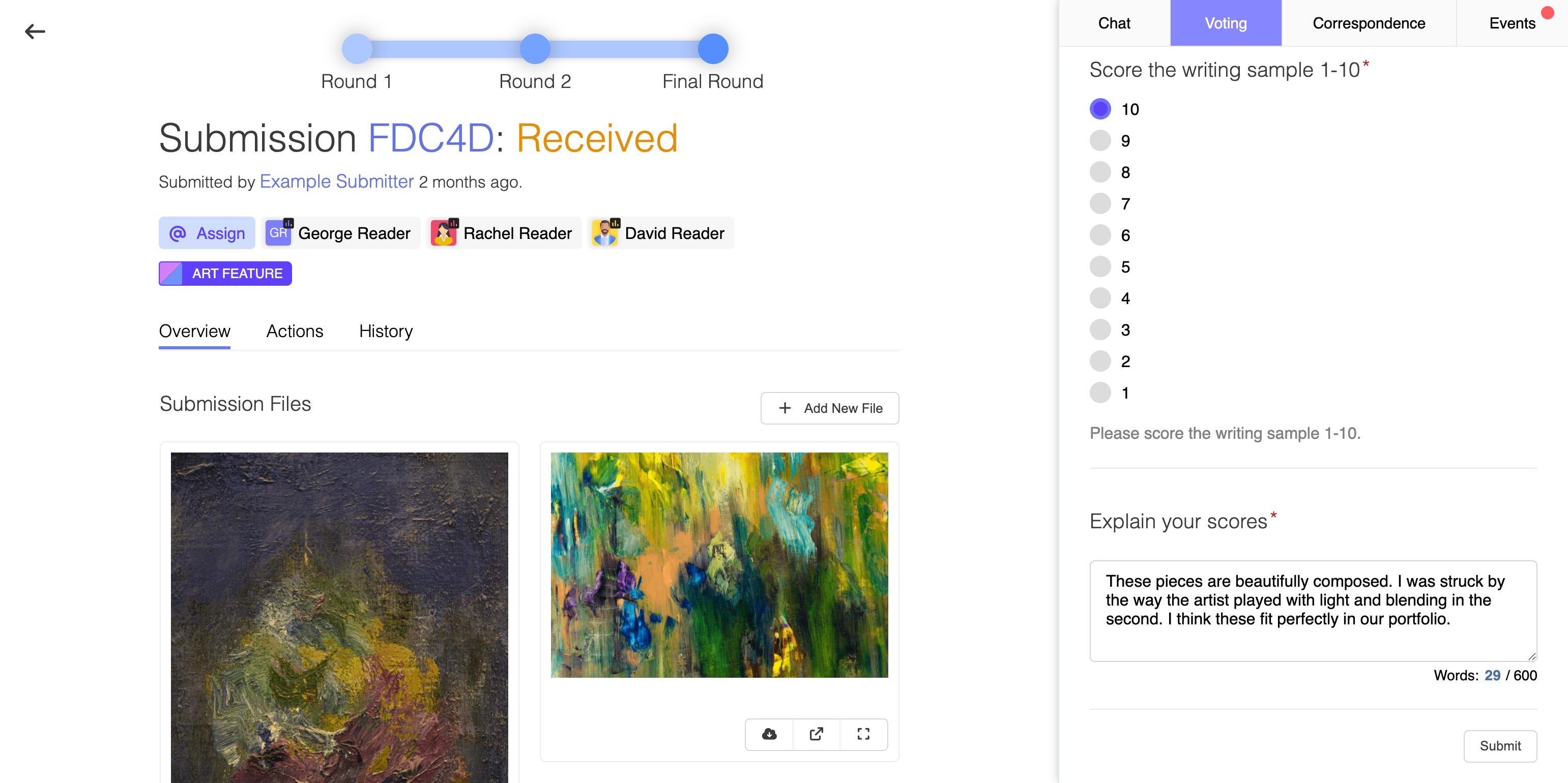
Many of the first design conversations were with AGNI, which prioritizes editorial conversation and collaborative review above voting. They don’t have a traditional “screening” round or review rounds at all. That means that even now, with all of the great voting and review-round features in place, real conversations about each piece remain the core of our design language. It’s like having an easy-to-find, dedicated Slack-like channel for every submission ever received. Each sub-specific channel retains the team’s conversations, reactions, mentions, files, and votes, and those are always available right next to the piece as the team reviews it.
When accepting work on Subfolio, the follow-up steps can happen right within the platform. Editors can converse with the author, ask for revisions, a bio, or an author photo, send a contract, receive the executed contract back, and pay the author.
Subfolio offers reasonable pricing, speedy payouts, and no limits on growth. The reality is that Submittable and other platforms place limits exactly where organizations need flexibility. It’s not that more account seats, for example, cost the platform more. It’s that organizations will outgrow artificial limits in those areas and feel compelled to “upgrade.” Subfolio operates differently.
We also keep monthly rates and commission pricing transparent—the Stripe dashboard gives you a real-time view of exactly what you’re earning and paying. We also describe exactly what you’ll end up paying, where some other platforms list only the commission they receive and bury the 2.9% + 30-cent processing fee that Stripe itself adds.
Subfolio is built on top of a whole ecosystem designed specifically for magazines and presses. With the flip of a switch, Subfolio can also turn into Subfolio + Demon later, enabling features for handling order management, renewal campaigns, royalties, automation, etc.
Q: How many use it to date for intaking submissions and have been onboarded thus far?
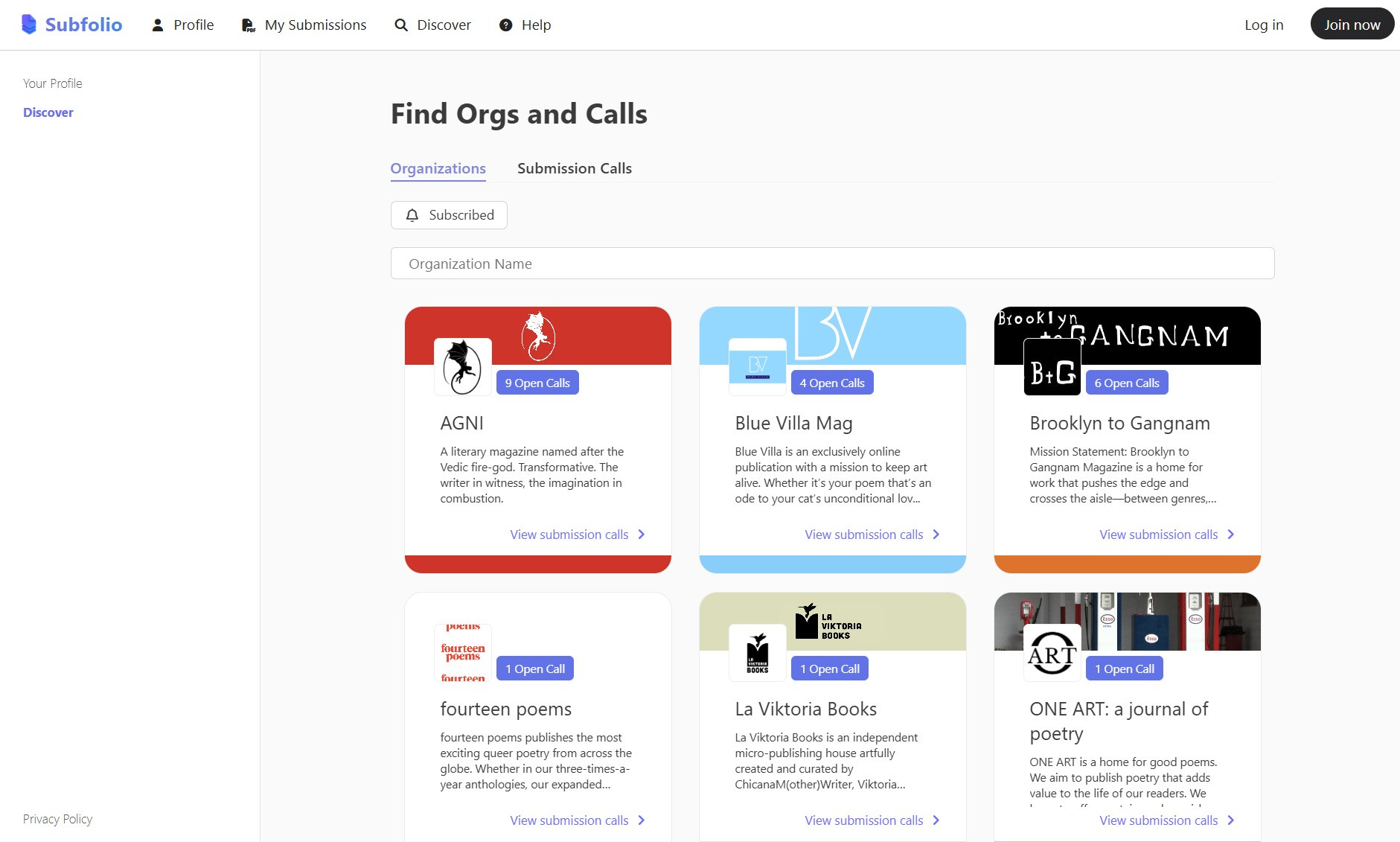
Liam: So far, the platform’s growth is really strong. We’re already hosting 28 organizations, with more on the way. As of November 2025, we have 14 organizations actively accepting submissions.
On board, we have AGNI, River Styx, One Story, Tupelo Press, Tupelo Quarterly, Dipity, and many others. So far in this first season, we’ve processed over 8,800 submissions and had just shy of 10,000 submitters create accounts!
One of the things I’m happiest about—we have a lot of smaller magazines signing up for the $10/mo. plan, including many places that would otherwise be using email or an alternative form builder. In my eyes, that’s a great sign that this will really help the community long term.
Q: For writers and artists, what value is there in going through publications on Subfolio, signing up, and submitting their work through it?
Liam: I think the portfolio feature makes things significantly easier for writers and artists. Many writers submit the same piece, whether simultaneously or serially, to a few different places. In Subfolio, when a submitter uploads a piece for submission, it’s saved to their portfolio and can be attached again from there. Of course, they can also upload revisions or other needed versions, for example, files with and without identifying information. Our forms are more modern than other platforms. The biggest distinction is that they just work. When submitters leave the page by accident, the system saves every change they made, meaning they can start in again where they left off. We automatically notify users when a submission needs attention, in part by sending email follow-ups.
For writers and artists, it’s also very easy to save specific submission calls or sign on for notifications about a specific org, so that they always know when their favorite magazine or press is opening or soon closing a reading period.
Q: Security, safety, and moderation are huge concerns for publications. What features does Subfolio already have in place or may develop in the future to address this?
Liam: A lot of my software background is in platform/information security, cryptography, and database design. Over the last 10 years, Demon has been completely free of security incidents, and Subfolio builds on the same painstakingly designed infrastructure. Keeping our systems safe is a continuous process, including pen-testing, code audits, and monitoring. Since we use major infrastructure providers, our physical security is very strong, and we have extremely strict production access controls. We actively monitor vulnerability releases related to every component of our stack, we patch regularly, and we use best security practices across the board.
The matter of plagiarism and AI submissions is a complicated one. I think our best asset in preventing plagiarism, AI submissions, harassment, etc., long-term is going to be community. I’ve added tools for flagging submissions and, when an organization feels it’s necessary, blocking submitters. Information on who is blocked where, and for what, is aggregated anonymously and used to take action against accounts that violate our terms.
There are many AI-detection tools out there, but even the best have low success rates and return a lot of false positives. I feel computers shouldn’t be judging human work. I personally don’t want that for our future. The vast majority of submissions will be human-written, and Subfolio should have no place in deciding whether any piece is worthy of consideration
Q: Tons of platforms are now incorporating AI or assistant tools. Does Subfolio intend to do that? Are there any AI systems tied to Subfolio?
Liam: Subfolio doesn’t incorporate AI, and we will never include AI in our platform. We have strong access controls and anti-scraping security in place for all files uploaded, and data submitted to Subfolio will never be sent to any AI provider. Of course, Subfolio can’t control what an individual magazine or press does with a file once they receive it, but I expect most literary organizations share that stance.
I don’t like the idea of writers’ and artists’ work being used to train AI, especially large language models (LLMs). I also don’t like the idea of AI (or even an algorithm) somehow defining what’s “literary enough.” In the design of Subfolio’s moderation tools, this was a key consideration. We provide human editors with robust tools for reviewing submissions and flagging problematic ones, but the platform itself plays no role, for any of our users, in rating submissions or deciding if a particular submission is worthy. We make editors’ jobs easier by setting up a forum-like infrastructure around each submission. But editors at every magazine and press bring something different to this work. We’re not about to pretend a bot could replace them.
Q: How cost-friendly is it for lit mags and presses?
Liam: Subfolio has the following:
For submitters, signing up and using Subfolio is always free. When signing up, the system is completely free until a call is actually live, so organizations can get set up worry-free well in advance.
For CLMP members, Subfolio can cost as little as $10/mo for organizations accepting fewer than 100 free submissions a month. If you receive more than that, you can take unlimited free submissions for $29/mo.
For organizations accepting paid submissions, our commission is much lower than Submittable’s. A lot of organizations may be overlooking how much they really spend, since the commission can be hard to see. We take a commission of 3.9% + 65 cents, which can save organizations a whole lot compared to Submittable. I wrote an article describing some of the math that’s helped us save organizations more than $10,000 a year—it’s linked here: “How Subfolio Saves You Money,” and it covers both Submittable and Duosuma.
Q: Publications utilizing Submittable often have a substantial archive history, a wide array of category calls, guidelines, and templates spanning across several years. Could you briefly describe how you ensure publishers have a smooth transition from other submission systems?
Liam: Great question. We have a system in place for gathering a lot of information from an organization’s active Submittable page, which can help make the transition far smoother. When signing up, the system goes to the organization’s Submittable page and can copy over the active calls, some of the images, like the banner, and so on. This means much of the landing page design, guidelines for each active call, and a few other kinds of information port over on their own.
It can’t duplicate all of the info on the forms, but it makes life a little easier.
For organizations with years of submission history, we’ve been doing large imports for many years. After signing up, just send us the export, and we’ll get the submissions imported for free. We can’t import old conversations or comments, but all of the core information will be there. For organizations with a lot of templates, we can import those too, whether they’re accept, reject, or message templates.
Now, for organizations that have switched, some have made a clean jump, and others have left their earlier platform open for a short period to help with the transition. So far, those changeovers have gone quite smoothly, and I’m happy to be directly involved to make sure they do.
Q: The IngramSpark or additional integrations look cool—could you tell us more about these optional add-ons to plans?
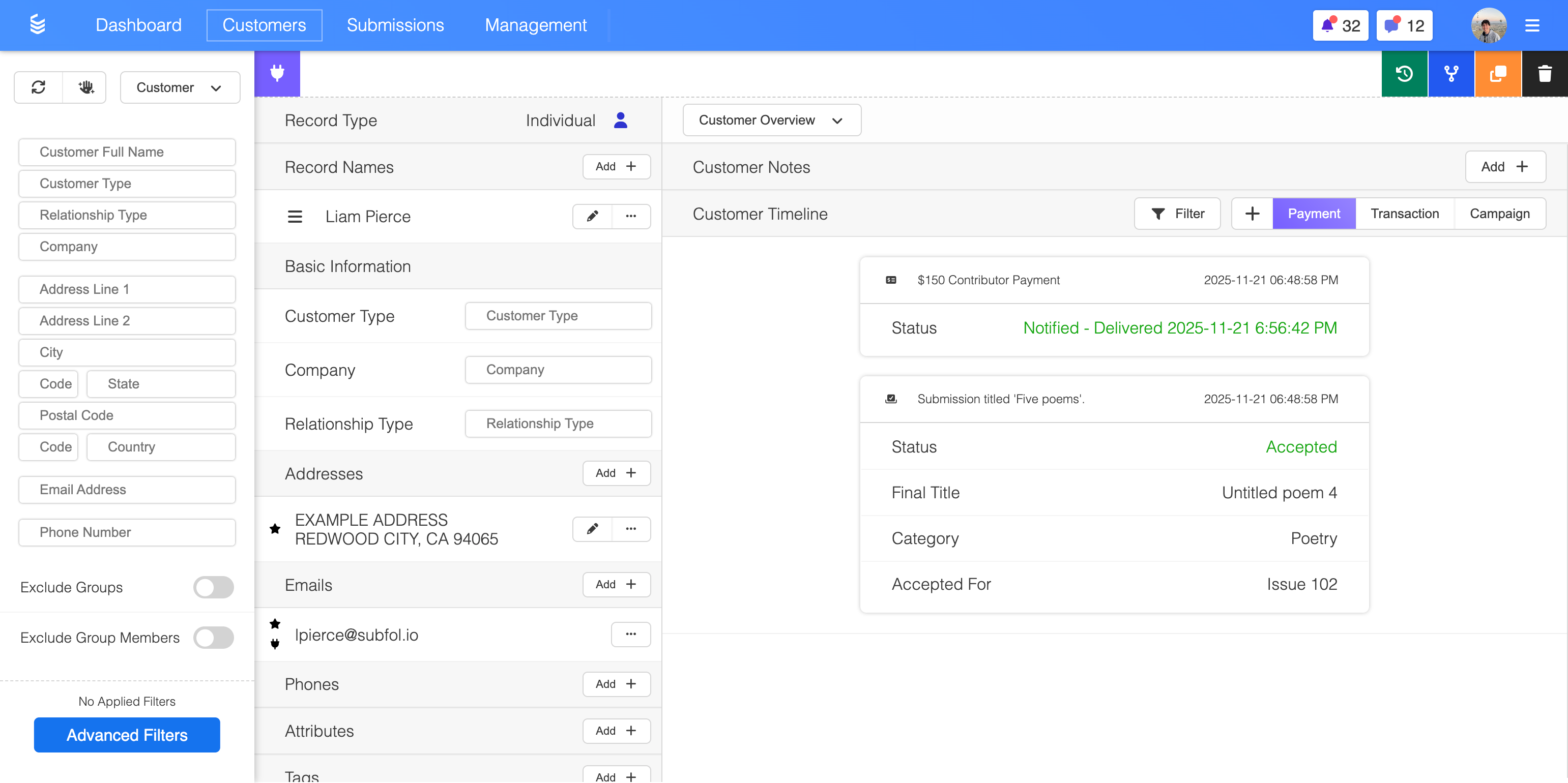
Liam: After Small Press Distribution shut down, a few presses came to me hoping to automate their print-on-demand with IngramSpark, and that’s what the IngramSpark tools do. Our IngramSpark automation, royalty tools, CRM-style tools, and so on, are available directly within the Subfolio administrative-side software as features that can be turned on. These let organizations automate order fulfillment, data entry, renewal campaigns, etc.
This means that if an organization adopts Subfolio and finds it wants powerful outreach and management tools, there’s turnkey access to those, directly connected to the data they already have with us. Of course, those aren’t limited to submitter data. We can also import FileMaker, Excel, and other databases, and connect an existing webstore (Shopify, Squarespace, WooCommerce, etc) to get order information updating automatically. Also, this gives mags and presses access to a full, integrated management system if they want that. It’s currently used by many world-class literary nonprofits. Some of them: New England Review, Archipelago Books, Arrowsmith Press, American Short Fiction, and, of course, AGNI.
Q: What does support look like for editors and submitters with Subfolio to date, or what will it look like in the future?
Liam: Support is one of the most important pieces of this whole ecosystem, in my mind. I’ve been putting a lot of energy into making sure this side of things goes right. Being able to get in contact with someone to help solve an issue can make or break a platform. I’m directly involved with support myself. I also have a small team active, and I plan to build out a larger support team. After just a few months of public release, we’re already approaching 10,000 writers on the platform, and support for them and for publishers has been going smoothly.
It’s important that we’re active beyond usual work hours for support, including on weekends. Many reading teams work with submissions outside of daytime, work-week hours, and writers, of course, submit all day and night. Support requests that come in late, even well into the night on the East Coast, can still be handled promptly on the West Coast, so support has been easy to cover so far. I’ve also invested a lot of time making videos and documentation pages for publications to refer to and support pages for writers. I’m confident we’ll be able to keep things running smoothly for everybody who needs help.
Q: What would you say to lit mags and presses leveraging just email or Google Forms currently for managing poetry, story, essay, etc., submissions, or those who say it’s a waste of money?
Liam: There are many problems with using email or alternative form builders. It’s a headache to manage the files, difficult to share submissions with a team, and hard to keep the next steps clear and organized. There’s also far less community reach for organizations that want to get more submissions. I think many who use Google Forms or email would love to have purpose-built features, but can’t justify the cost. My hope is that our $10/mo. plan will help those organizations thrive. So far, those who’ve switched away from alternative platforms or email have told me Subfolio saved them from a “hodgepodge of applications” they were using to manage submissions.
Q: What are some other exciting things ahead you’d like to share in regards to Subfolio?
Liam: There are a lot of features in the pipeline, and I am going to continue posting about them on our Substack! Check it out at subfolio.substack.com, and subscribe if you want to see updates! It’s free, of course.
Connect With Subfolio Today
Be sure to visit their website: https://subfol.io/
Feel free to reach out to Liam about any further questions that you may have, or if you’re interested in learning more, you can of course always request a 1-on-1 demo and start a free trial. Lastly, don’t forget to check out the documentation at: subfol.io/docs. Their YouTube channel, linked below, is packed with videos. Subscribe and watch the “Learning Subfolio: Administrator Edition” step-by-step tutorial videos here too. The main page can also be found here at: subfolios.com. Thanks so much, Liam, for taking the time to share more about Subfolio!
Learning Subfolio: Reader Orientation
After reading the interview, are there any thoughts you’d like to share on Subfolio or on the existence of submission management systems in general?
