

Things That Discourage Submissions to Literary Magazines | Red Flags & Scam Recognition


This technically applies to tips for submitters, but also new founding editors, more so, covering this too, what to look out for, and keep in mind:
Long-winded statements and letters tied to sub guidelines and policies, when your guidelines are far too long, several pages to scroll through—that’s going to be super tough on the writer and artist, confusing even and they’ll miss things—too long—not straight to the point, or too short (vague in detail) and they’ll find loopholes in them—be thorough but “keep it short and sweet.” Chapbook manuscript and contest guidelines on sites tend to be a tad longer, which is totally ok, though—I prefer collapsible guidelines—it’s nice to use a submission system too because you can input reminders and reiterate the exact guidelines for each call tied back to what’s summarized or bullet-pointed on your website, etc.
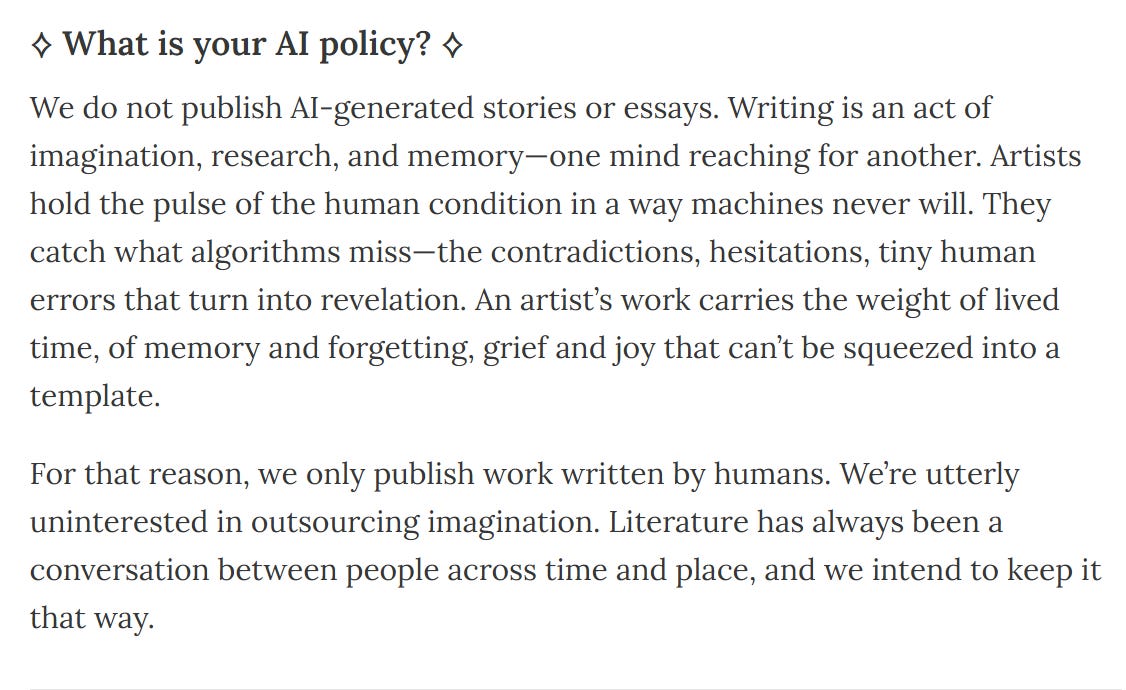
Accepting AI work is a big no-no in my eyes—I only support traditional, human-made art and writing. This is, of course, controversial, but over 90% of the people in the lit mag world I know DO NOT support AI-generated work or tools. Submitters who don’t support AI will avoid your publication, of course.
Here is an example of a good bite-sized and straightforward AI policy from Strange Pilgrims:
Stating “we have no guidelines,” isn’t good, this may welcome a free-for-all approach or completely overwhelm your reading team or yourself in terms of volume; obviously, every publication has things they specifically look for, most editors have things, subject matter like and don’t like to see, e.g. generic cliche rhymes, so please indicate length requirements, whether or not cover letters are required or if identifying info is concealed, word count or line limits if any, allotted amount of poems, art, or stories, etc., at a time, how often one can submit after an acceptance, whether international submissions are permitted etc. Take some time to read the guidelines of other longstanding lit mags and journals (4-10 years old) and use them as a blueprint for what to keep in mind when creating your very own calls and guidelines from scratch in your own words. You must have guidelines and an FAQ page—otherwise, submitters will struggle, and it helps minimize repeat questions to your inbox.
Invisible masthead info—no names of who’s running it or where it’s located—will ultimately create question marks. It’s not necessary to include photos; however, submitters feel more comfortable when they can clearly see who's behind the operations of a publication, including a first name and last name and staff title(s). It shouldn’t be a mystery or hidden who is on your team, of course. If you’re an editor and concerned about privacy, use a pen name you can be addressed by, and put the state or country at a minimum. If you do apply for your ISSN, they do require a visible city location on your website and within your publication issues. Submitters do read masthead info and bios, so include a staff and about section, but do not have them play a game of CLUE or GUESS WHO.
Publishers with insanely high fees or ones asking for a boatload of money upfront are huge RED FLAGS; most submitters who see fees will not submit to a publication at all or completely avoid them. Once in a blue moon, yes, submitters may pay tiny sub fees—$1-5 or much lower in range, but fees that are $6-$20+ for general subs seem really fishy and too high. There are a lot of fee-free opportunities out there, so as I’ll say again, really ensure that you’ve exhausted all options before implementing any fees, e.g., Patreon or a fundraising event. I have seen pop-up shops or vanity presses charge $50-$100 or more—eyebrow-raising amounts. Contests in the lit mag world tend to be $18-$20 or more, however, those usually have a jumbo cash prize awarded to one or more of the finalists, some do give a one year subscription to issues too. Again, fee free contests are out there and submission opportunities, as a submitter it makes sense to pivot towards FREE first.
Bad tip structures—tips SHOULD NEVER be required for submitters; they should be OPTIONAL after one submits or before. DO NOT require tips or donations.
A needle-in-a-haystack “Submit Work” button is going to cause a WHERE’S WALDO? situation; submitters shouldn’t have their mouse cursor hip-hopping around multiple pages to find where to go—the location of guidelines and where to submit should be found in a matter of seconds. It’s ok to direct them to your submission management system landing calls page, but no links should take you out to bizarre, irrelevant, or suspicious slot machine-type pages or have tons of back-to-back pop-ups and a flood of strange advertisements and inappropriate products.
Just because a publication has a website doesn’t mean it’s legit. There are places out there with Fake 5-star glowing reviews littered on the site and machine-generated work posted, some pop-up shops have a bunch of AI-generated content spun up, covers, etc., or fake publishing houses and made-up names exist, or impersonators. Be aware of how to identify AI work—it can be hard, and there are tools out there, a clear giveaway when you examine it further carefully, but it’s hard to do with your eyes, and no tool is 100% perfect or accurate.
Investigate editors a bit with quick Google and LinkedIn searches, NEVER reply or click on any suspicious emails outright asking for your work—stating you supposedly just have to pay a fee to do so, etc., or to exchange personal info—look carefully at sender addresses—people have tried impersonating me before too, a lot of lit mags and journals have a dedicated submission system or instructions on their website and do not handle any submissions via email, but not all, so it’s tough—compare sender addresses and hovering over links can reveal their true URL. If you’re ever unsure, it’s best to NOT respond, DO NOT click on any links at all, and delete the email.
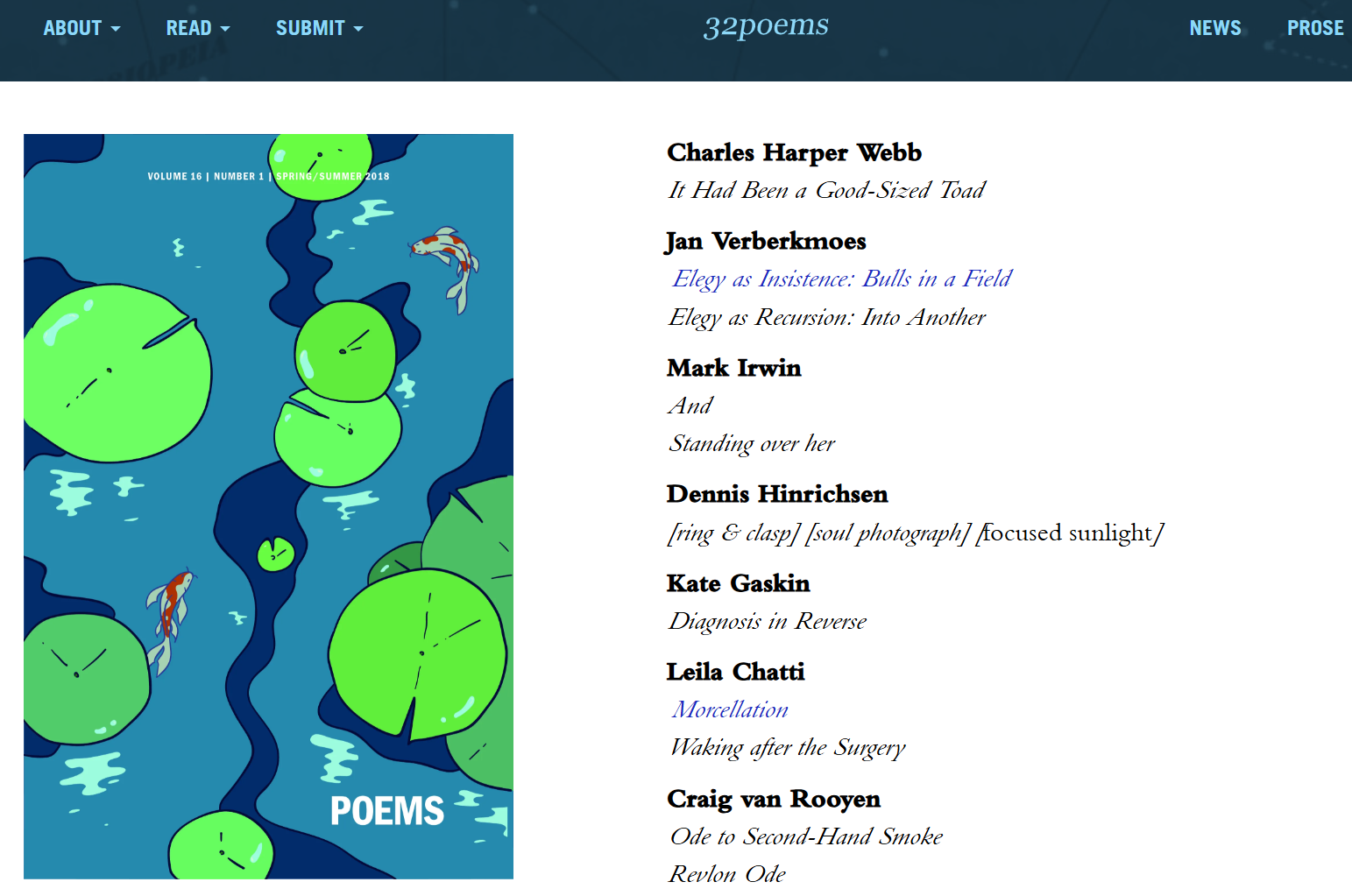
Seeing everything paywalled or running into every published piece requiring a subscription for access is NOT a great reading experience and is frustrating—you should give visitors and potential submitters at least one free issue sample, preview pages, etc., to flip through or have at least make a few FREE pieces, e.g., poems, available to read on the website from back issues so they get a sense of what the publication looks for or has accepted in the past.
Here’s a great example of 32 Poems Volume 16 Number 1, offering a few pieces, two linked in blue, that are free to read online:
Publishers are reaching out aggressively, stating they are “short on work” but have hefty fees implemented or are asking you to pay up to do so—yes, some publications with minimal fees $2-$5, are genuine publications that use those fees to cover expenses or pay writers for their work and send reminder messages through Submittable when you for instance abandon a saved draft, but in most cases those reminders or notifications are just a way for them to grab some more cash. Remember to delete your drafts on fee-required publishers, e.g., within Submittable, that you have no interest in submitting to and do research on them—look at search results under their name, scan Reddit boards, Chill Subs ratings overview pages, the Better Business Bureau, social media posts, Substack comment sections of Lit Mag News, other writer news blogs, and take some time to see whether others have noticed scammy behavior.
“Too good to be true,” promising publication, a marketing package deal and more and practically guaranteeing an acceptance, or even asking for a bunch of personal information, to just join a group they’ve created of some kind and asking you to cough up money, at most, with submission systems like Submittable, your name, email, and preferred mailing address is provided, but nothing more—your submission should be reviewed carefully by a publication’s editor if solo run or undergo team rounds for fair consideration—you shouldn’t have to pay up chunks of money to become published at all.
Complicated Terms & Conditions and Privacy Policies or third-party organizations mentioned with no clear names behind them either, as we discussed on the podcast a tad, and referred to past discussions over on Lit Mag News, scroll down to the very bottom of websites, and on a lot of lit mags and presses, you’ll be able to view and read those, yes they can be long typically but you should examine those carefully before engaging with a publication further, honestly most have quite similar wording and sections but NOT all.
A conga line of KING KONG grammatical errors—when a submitter sees a ton of errors or huge hiccups in guidelines, paragraphs, etc., across the site, this could be a major turn-off as well, and gives a publication a yellow or red card, too. A few typos here and there are ok, we’re all human, but in every line or nearly every single one in the guidelines SHOULDN’T have errors in them—it creates a really poor experience for potential submitters, and they may feel that the editor is inexperienced or sloppy.
ZERO contact info—a publication should have a visible contact e-mail address for general questions, or better yet, a contact form/inbox section where the editor could be reached aside from, for instance, the submission management system.
Having constantly outdated or mismatched information can be detrimental to a publication’s success; it’s essential to update a lit mag site regularly, ensuring that your calls in the submission management system align with, for instance, what’s stated or outlined on the website. Submitters will move on if the publication looks like it’s been abandoned, or mistake it as on hiatus if much older calls are visible first to them.
SUPER PRICY issues—are the print or digital issues reasonably priced? If not, contributors will probably look away unless free or deeply discounted copies are provided.
LACK of CONTENT WARNINGS—while not mandatory, there are times I have come across some lit mags with very few or non-existent content and trigger warnings over writing and rather graphic photos or art. While some may be ok without those, not everyone, so it’s important to consider implementing a line at least in advance, an indicator, or a stoppage of some kind to give a heads up.
After reading, any experiences of scams you’d like to share or odd behavior you’ve noticed in the lit mag world in general that bothers you?
